

GOÄneu begins in the inbox
GOÄneu is changing private medical billing more fundamentally than at any time in over 40 years. Every private health insurer must therefore prepare its incoming invoice process for it: new fee codes, fixed prices instead of a multiplier, two legal frameworks in parallel, and ongoing adjustments after launch. GOÄneu offers an opportunity to rethink historically evolved processes: wherever manual intermediate steps compensate for technical limitations or quality deficiencies, better processes are needed. The goal is input management that avoids media discontinuities and passes complete, professionally usable information on to claims processing.
Before an invoice can be reviewed and reimbursed, it must be identified at intake and assigned to the correct set of rules. With GOÄneu, this very first step becomes more demanding. Every error at intake carries through to reimbursement and creates clarification cases and effort in reindexing. As a result, waiting times and policyholder enquiries increase.
As expectations for the use of AI grow, it is necessary to question more closely how much additional automation and straight-through processing the existing architecture allows. Can new AI methods and agentic technologies be meaningfully integrated and, above all, operated in a controlled manner? How well can systems be maintained and further developed over the long term, especially when changes are repeatedly needed as part of GOÄneu?
Input management is needed that makes AI usable for more straight-through processing and can be operated in a controlled manner and further developed over the long term.
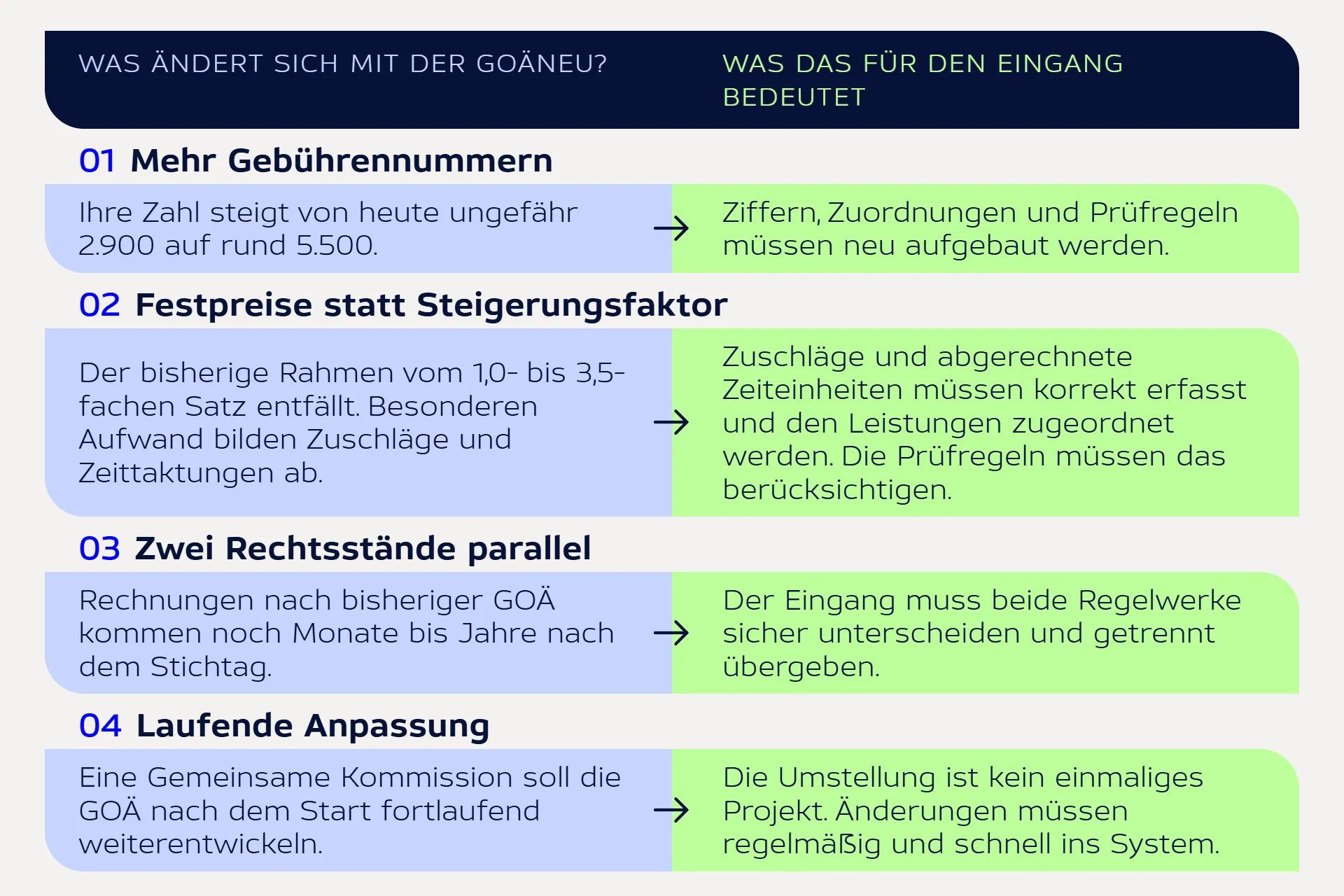
What is changing with GOÄneu?
The basis is the joint draft by the German Medical Association (BÄK) and the Association of Private Health Insurers. For you, this means:
How does the transition from the old to the new GOÄ work?
The legal section of the draft clearly regulates the transition. Three points are important for intake:
The date of service is decisive: The previous GOÄ continues to apply to services provided or begun before it enters into force (Section 13 (2) of the draft).
No mixed invoices: An invoice under the new GOÄ may not contain services under the old GOÄ. Anyone receiving treatment across the cut-off date will therefore receive two invoices.
Regular changes in the system: Different invoice layouts and invoices submitted later require ongoing adjustments to recognition.
For claims processing, this means that a case may include invoices under both sets of rules. Each must be extracted and reviewed according to its own set of rules.
When does GOÄneu enter into force?
There is no binding date yet. The BÄK and the Association of Private Health Insurers consider 1 January 2028 achievable.
The next steps
May 2025
The 129th German Medical Assembly approves the joint draft. In June, it goes to the Federal Ministry of Health (BMG).
31 July 2026
The BÄK and the Association of Private Health Insurers submit an updated version.
Summer 2026
The BMG reviews the draft. Individual professional associations call for improvements.
Announced for 2026
Ministerial draft by the BMG, followed by consultation, Cabinet and Bundesrat
The target is 01 January 2028
Entry into force, not yet binding.
Why GOÄneu is a reason to rethink intake
All systems must support GOÄneu. The new set of rules alone therefore does not make intake better. The greater lever lies in a different question: How many documents does a person still need to handle?
If the system indicates how certain it is about every extracted item and shows where it appears in the document, your teams only need to review documents where something is uncertain or implausible. All others pass through without rework. Double-checking because no one trusts the result becomes unnecessary.
For input management in private health insurance, there has long been little choice. A change reaches deep into a central business process and requires a perspective beyond the next regulatory adjustment: processing invoices faster, relieving teams of manual rework, and implementing new requirements without launching a major IT project every time.
To achieve this, processes and review logic must also be able to evolve. Those who merely automate historically evolved processes with more powerful models retain their detours and exceptions. Greater autonomy emerges when your business departments contribute their knowledge themselves: with no-code, business rules can be adapted, tested and transparently approved within defined guardrails. Further development then depends less on individual specialists or the vendor's capacity.

Three questions for your current system
Does your system automatically identify for every invoice whether the old or the new GOÄ applies and pass both on separately?
Can you implement and test adjustments to the set of rules yourself without waiting for the provider?
Do your AI models learn as documents change?
Invoice images and formats are changing ever faster. A system should be able to learn from new examples without you having to wait for the next vendor update.
If you answer no to any of these questions, it is worth taking a closer look. You can find the complete self-assessment with five questions on GOÄneu here:
How Buildsimple PKV prepares your intake for GOÄneu
Buildsimple PKV is a ready-to-use specialist package for the input management of private health insurers. It is prepared for GOÄneu and processes documents under GOÄ and GOÄneu in parallel.
- Assign correctly and create business cases appropriately. Invoices from apps, email, uploads, scans, mail and APIs are separated, classified, assigned to the appropriate set of rules and processed accordingly. Business cases can be created automatically based on their specifications and professional requirements.
- Business data for each line item. Extracted data includes identifiers, service providers, the date of service for each line item, fee codes, surcharges, amounts and diagnoses. Every field has a confidence level and a source location in the document.
- Review before handover. The validity of fee codes on the date of service, totals, treatment periods and further professional criteria are checked. For uncertain or implausible results, your team receives a specific indication of what needs to be checked.
- Implement professional requirements faster and in a controlled manner. Document classes, fields, rules, thresholds and AI models can be adapted without programming. Changes are tested in a separate environment and only put into production after approval. This allows business department requirements to be implemented faster.
- Everything traceable. Every action is logged. Dashboards show throughput and quality, as well as the progress of your straight-through processing.
- Deployment of your choice. Cloud operated in Frankfurt, AWS European Sovereign Cloud with EU data residency and operation by EU personnel, or Buildsimple EDGE for processing in your own data centre.
Buildsimple passes the fully prepared case on to your specialist department. Tariff, entitlement and reimbursement decisions remain with you. This gives your team time for the cases that need time.
A transition does not have to begin with risk: in shadow operation, Buildsimple PKV runs in parallel while your existing system remains the leading system. The migration takes place gradually.
We will show you what happens at intake using three of your own invoices
30 minutes, no obligation, with our private health insurance specialist expert, gladly together with your claims department
Frequently asked questions about GOÄneu
FAQ
There is no binding date yet. The German Medical Association and the Association of Private Health Insurers consider 1 January 2028 achievable. The new GOÄ is a statutory instrument and requires the approval of the Bundesrat. Until then, the previous GOÄ applies.
The multiplier is eliminated. Each service is assigned a fixed euro amount. Special effort is reflected through surcharges and time increments. In addition, the schedule grows from around 2,900 to around 5,500 fee codes.
According to the draft, the previous GOÄ applies to services provided or begun before it enters into force. Mixed invoices are not permitted. The date of service, not the invoice date, is decisive.
A body comprising the German Medical Association, the Association of Private Health Insurers and aid cost bearers that is intended to further develop the GOÄ after launch. It recommends changes to service descriptions and valuations, which the Federal Ministry of Health can implement.
Set up incoming invoice processing so that it reliably separates both sets of rules. In addition, related documents should be passed on as a case and rule changes should be incorporated without long release cycles. GOÄneu projects are already underway at many insurers.
AS OF 16 November 2026
Sources
German Medical Association: FAQ on the new GOÄ (12/2025) (https://www.bundesaerztekammer.de/fileadmin/user_upload/BAEK/Themen/Honorar/GOAE/FAQ_GOAE__12.2025.pdf)
German Medical Association: Legal section of the GOÄ draft, comparison with the 2025 Medical Assembly version (09.07.2026) (https://www.bundesaerztekammer.de/fileadmin/user_upload/BAEK/Themen/Honorar/GOAE/2026-07-09_Rechtsteil_GOAE-Entwurf_Vergleich_zu_Version_DAET2025.pdf)
German Medical Journal: GOÄ draft revised again (31.07.2026) (https://www.aerzteblatt.de/news/goa-entwurf-erneut-uberarbeitet-verordnungsverfahren-lauft-weiter-3108be32-b2fb-48f2-ba0c-e9f18c6f4da8)
Association of Private Health Insurers: GOÄ draft, successful update (https://www.pkv.de/verband/presse/pressemitteilungen/goae-entwurf-erfolgreiche-aktualisierung-als-basis-fuer-ein-zuegiges-verordnungsverfahren/)
Medical Tribune: New GOÄ could become reality in 2028 (31.07.2026) (https://www.medical-tribune.de/praxis/honorar/neue-goae-koennte-2028-real-werden)
Rhineland Medical Journal: Updated version submitted (09/2026) (https://www.aekno.de/aerzte/rheinisches-aerzteblatt/ausgabe/artikel/2026/september-2026/aktualisierte-fassung-vorgelegt)
AWS: Opening the AWS European Sovereign Cloud (15.01.2026) (https://aws.amazon.com/de/blogs/aws/opening-the-aws-european-sovereign-cloud/)
Medas: New GOÄ, status quo and planned changes (https://www.medas.de/medas-wissen/infothek/die-neue-goae/)