

What is Human-in-the-Loop in intelligent document processing?
Intelligent document processing (IDP) reads incoming documents, assigns them to a case and prepares them for further processing. This includes emails, applications, invoices, reports or supporting documents. Every result is associated with a confidence score: a value indicating how certain the system is about a recognition.
Human-in-the-Loop comes into play where automation reaches its limits. Human-in-the-Loop determines what happens with this score. If a result is above the threshold you have defined, it is further processed in a controlled manner. If it is below the threshold or the case deviates from known patterns, it is displayed to your team for review. Your specialists then specifically see the cases where their knowledge, experience or approval is required. This makes Human-in-the-Loop an integral part of quality assurance. Your team reviews less routine work and more cases that genuinely require expert assessment.
When is your team involved?
The rules you define determine whether a case proceeds automatically or is reviewed. Typical reasons for a review include:
The confidence score is below a threshold. A field was not recognized with sufficient certainty, for example, an illegible account number.
Information is missing. A document required for the case has not yet been received.
Information is contradictory. The amount on the invoice does not match the amount in the application.
A case deviates from known patterns. A new document type appears or a case progresses unusually.
An expert decision is required. The assessment remains with your team.
Regulatory approval is required. Certain steps need documented human confirmation.
An action carries increased risk. For example, transferring data to a specialist system with financial consequences.
A specific process step can be defined for each of these cases: formulate a query, request missing documents, flag a deviation for review or transfer the case to the responsible department. These context-based suggestions are often referred to as Next Best Action. This gives your team a transparent basis for making decisions and means they do not first have to gather the initial information themselves.
What is Human-in-the-Lead in intelligent document processing?
What is Human-in-the-Lead?
Human-in-the-Lead describes control. You determine how far automation may go in your process. To do so, you define:
Goals and rules: Which document types and cases are processed automatically?
Confidence thresholds: At what level of certainty may a result proceed without review?
Approval points: Which steps always require human confirmation?
Escalation paths and responsibilities: Who is responsible when a case cannot be decided with certainty?
These settings are not set in stone. Depending on their permissions, your specialist department can adjust them independently. If a document type is running reliably, the degree of automation can be gradually increased. You start cautiously and increase the pace as soon as the results allow it.
Human-in-the-Loop and Human-in-the-Lead: Who sets the rules?
Both terms sound similar and describe two levels of control.
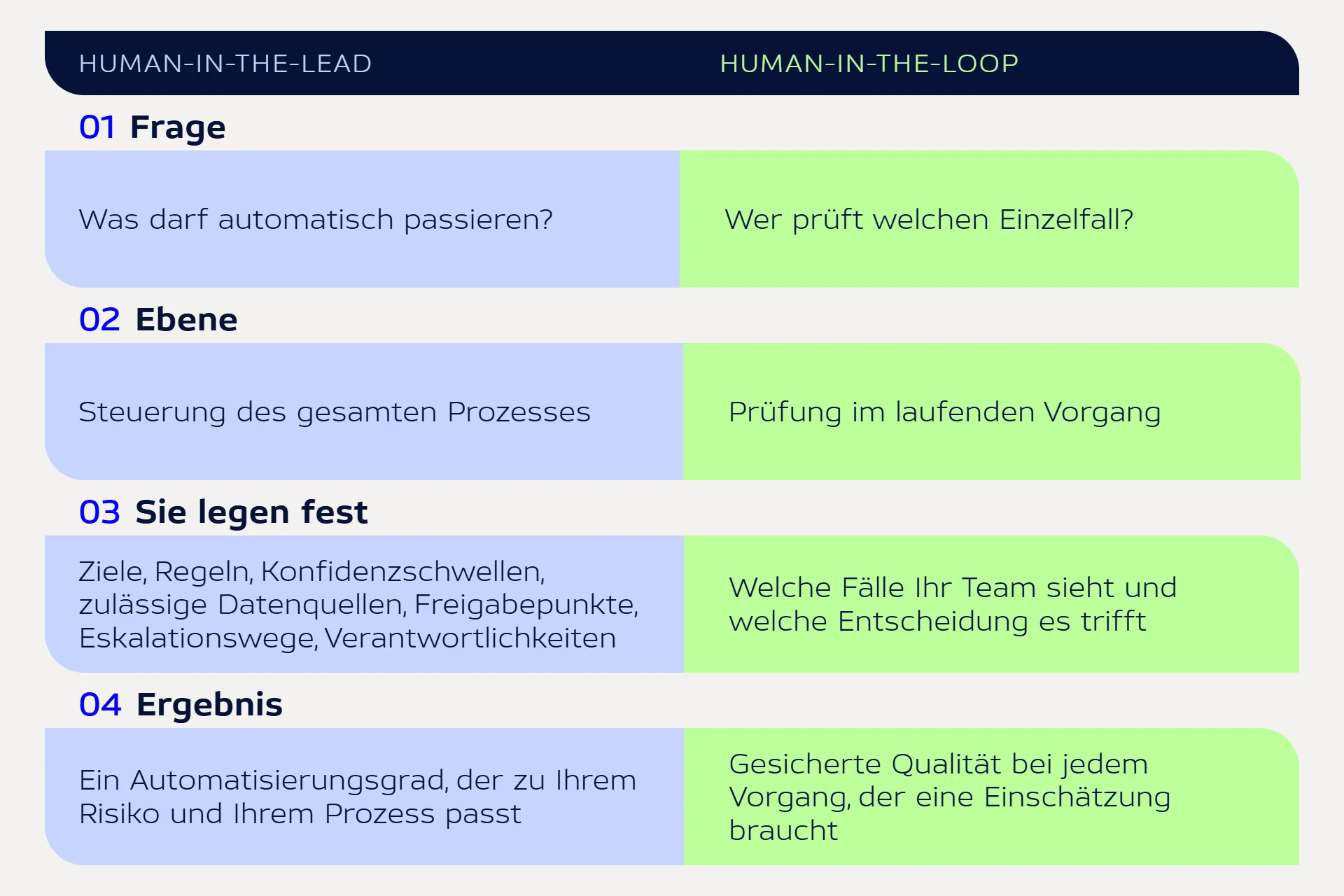
Human-in-the-Lead means: You determine the degree of automation. Human-in-the-Loop means: Your team is involved at the points you have designated for it. In both cases, the expert and legal decision remains with you.
How Lead and Loop work together
The two levels interlock. In Lead, you define the threshold. In Loop, your team reviews everything below it. And each of these reviews shows where recognition still needs to be refined. Using these insights, you adjust rules and thresholds in Lead. This creates a cycle in which processing becomes more reliable with every round.
Many teams fear that human review points will slow down automation. In practice, the time savings come precisely from targeted review. Without clear thresholds, your team would have to check every result when in doubt. With clear thresholds, standard cases pass through automatically, and your team focuses on exceptions and technically demanding decisions.
A high straight-through processing rate, meaning the proportion of cases without manual review, is not an end in itself. It must fit your quality requirements, your risk and your process.
Which confidence threshold is the right one?
Each company sets the threshold itself. An example: You decide that an extracted field may proceed without review from a confidence score of 97 percent.
The IBAN on an invoice is recognized with 98 percent confidence. It is above your threshold and is transferred directly to the specialist system.
The IBAN on a form supplemented by hand is recognized with 82 percent confidence. It is below the threshold and appears to your team together with its location in the document. A case worker confirms or corrects the value in just a few seconds.
Quality requirements are increasing. Where 95 percent was once common as an approval threshold, today the goal may be to reach 99 percent. Higher thresholds mean greater certainty. To ensure that this does not result in more cases reaching the team, recognition must improve accordingly.
This requires targeted training, especially with documents that are difficult to read:
Handwriting, such as completed forms, notes or signature fields with additions
Deletions and corrections, where the valid value must first be identified
Old or poorly preserved documents, faded copies, faxes or archived records that are barely legible even for people
These cases in particular often end up in the Human-in-the-Loop at first. Every review by your team shows where recognition still needs to be refined. Step by step, this creates processing that reliably reaches higher thresholds as well.
How a case proceeds: two examples
A bank’s lending department.
Annual financial statements, bank statements, tax documents and supplementary supporting documents are received with a loan application. The platform assigns the documents to the application, extracts the relevant values and compares them with customer and application data. If all information is complete and plausible, this creates a transparent basis for review. If an annual financial statement is missing or a value deviates, your team sees the case along with an indication of what is missing and can request the missing document directly. Your team continues to make the lending decision.
An insurance company’s claims department.
Claims notifications, invoices, reports, images and legal correspondence arrive through various channels. The platform recognizes the document type and business transaction, assigns the documents to the claim and checks completeness. Clear-cut documents are transferred to the claims system. An appraisal with an unclear amount or a previously unknown document type is sent to the case worker, together with its location. Your team decides on coverage.
The underlying process is the same in both cases:
A document or email is received.
The document type and business transaction are recognized.
Relevant information is extracted.
The data is compared with master data or case data.
Completeness and plausibility are checked.
Reliable results are further processed in a controlled manner.
Uncertain or deviating results are displayed to your team.
Approved information is transferred to the target system.
You define which results are considered reliable in step 6 in Human-in-the-Lead. Step 7 is Human-in-the-Loop. Together, they ensure that only information that has been checked, either automatically or by your team, reaches step 8.
How to recognize a robust implementation
When comparing providers of document-based process automation, these questions can help:
Can you define confidence thresholds yourself, by document type or by field? A single threshold for everything results in either too much review effort or too much risk.
Can your team see why a case needs to be reviewed? A note such as "Amount differs from application," together with its location, saves search time.
Is every decision transparently logged, both automatic and manual? Regulated companies need this traceability, for example in view of requirements under the AI Act or DORA.
Can your specialist department adjust rules without starting a development project for every change?
Are escalation paths and responsibilities defined so that no case remains without an owner?
Where the Human-in-the-Loop principle makes the difference
Even very good automatic recognition does not reliably read every field. The final percentage points of quality are achieved where your team reviews, corrects and approves. Human-in-the-Loop therefore closes the gap between very good automatic recognition and a result your specialist system can rely on.
TALK TO US ABOUT YOUR PROCESS
Would you like to know where review points make sense in your inbound process and where cases can proceed automatically more quickly?
This content is only shown once you have accepted the relevant cookies.
Frequently asked questions about Human-in-the-Loop and Human-in-the-Lead
FAQ
Human-in-the-Lead describes control: You define what may happen automatically and who approves what. Human-in-the-Loop describes review during an ongoing case: Your team specifically reviews the cases that the system cannot decide with certainty.
Yes. Without Lead, there are no clear rules about which results may proceed automatically. Without Loop, there is nobody to review uncertain cases. Only together do they create a process that is both fast and controlled.
A confidence threshold is the minimum value at which an automatically recognized result is further processed without manual review. If the confidence score is below it, your team reviews the case. You define the threshold and can adjust it by document type.
Each company decides this for itself. To ensure that higher thresholds do not lead to more manual review, recognition is specifically trained with difficult documents, for example with handwriting, deletions or old, poorly legible documents.
When used selectively, Human-in-the-Loop accelerates the process. Routine cases proceed automatically, and your team reviews only cases that require expert assessment. Without this separation, every result would have to be checked when in doubt.
Human-in-the-Lead describes control: You define what may happen automatically. Human-in-the-Loop describes review during an ongoing case: Your team is involved at the designated points.
Your team. The platform prepares cases, identifies missing information and suggests specific process steps, for example a query or an expert review. Lending, coverage or benefits decisions remain with you.
As high as fits your quality requirements, your risk and your process. Many companies start with cautious thresholds and increase the degree of automation as soon as a document type runs reliably.