From 2,000 documents per week to an automated loan pipeline
- How DFKP uses Buildsimple to cut manual effort by 70% while collecting more data points than ever before.

The starting point: Manual operation at its limits
DFKP (Deutsche Firmenkredit Partner) is one of Germany’s largest independent financing brokers. ISO-certified and specializing in German small and medium-sized enterprises (SMEs), the company arranges corporate financing ranging from around 10,000 euros to millions—through a network of more than 200 banking partners and lenders. Its core business: aggregating, processing, and enriching documents, thereby relieving both clients and banking partners of the manual workload.
Documents are not a side issue here; they are the process itself. Annual financial statements, business analyses, trial balances, bank statements, tax documents, articles of incorporation, identification documents: Without them, there can be no prescoring, no qualified credit decision, and no offer from the financing partner.
“We’re turning documents from a bottleneck in the analog process into an enabler in the digital process.” – Maximilian Dassler, Specialist in Digital Credit Processes, DFKP.
The problem at a glance
Between 2,000 and 3,000 documents per week—over 100,000 per year—had to be manually reviewed, classified, and processed by a dedicated team. The range of document classes alone encompassed around 200 different types, with 10 to 15 core classes accounting for the lion’s share of the volume. Two to three full-time positions were dedicated exclusively to this task—capacity that was lacking in the subsequent process.
Compounding the problem was the heterogeneity of the input channels: documents arrived via email, through the customer portal, and via API—each channel with its own structure, each document requiring individual processing. Bank statements were the biggest pain point: 300 to 400 different banking systems, no standardized format, and even correctly identifying the billing period was extremely time-consuming when done manually. The real problem behind this was a lack of scalability. Higher volumes automatically meant more staff, with all the consequences that entailed: longer training periods, quality fluctuations due to employee turnover, and bottlenecks during peak volumes.
The solution: A two-stage AI pipeline with its own routing
DFKP evaluated various approaches: enterprise OCR solutions, in-house ML models, and several IDP providers. The requirements were clear: support heterogeneous document classes; provide an all-in-one solution combining separation, classification, and extraction; ensure data protection as a fundamental requirement; achieve a fast time-to-production; and offer the ability to control and retrain the system independently.
The deciding factor in choosing Buildsimple was a key testing approach: DFKP used complex real-world cases from the very beginning—not synthetic sample documents, but actual, diverse documents from day-to-day operations. The platform proved its worth.
Architecture: How the Pipeline Works
Level 1: Foundation Model:
The trained base model handles classification and extraction. Separate confidence thresholds are defined for each document class. Documents that exceed the threshold are processed fully automatically—without manual review.
Level 2: LLM for complex cases:
If a document falls below the threshold, a large language model takes over. It can handle unusual variations, missing structural elements, and atypical formatting. Routing occurs not only at the class level but also within a class—some variations of a financial statement are processed directly, while others require the LLM.
Control remains with the customer:
DFKP is solely responsible for the technical control logic. Buildsimple provides the platform—DFKP determines which documents are processed and how, what error rates are acceptable, and when each model is used. Thresholds are calibrated during regular reviews based on actual production data.
Human-in-the-Loop: Quality Assurance as an Integral Part of the System
Full automation is not a goal to be pursued at any cost. Documents that do not meet the minimum thresholds are forwarded to a dedicated quality team at DFKP. Buildsimple’s intuitive editing interface makes the review process efficient.
Corrected results are automatically fed back via API and used as training data. Consultants in the subsequent process can flag documents that appear to have been misclassified. The system learns as it operates—the blind processing rate increases continuously.
Implementation: 3 months from kickoff to go-live
The POC launched in early 2025 and was not a sandbox operation from day one. Real documents, real volume, real error rates. We started with the 10 to 20 document classes that account for 85–90% of the total volume—classification and extraction were trained together from the very beginning.
What made the unusually short ramp-up time possible: DFKP provided pre-labeled data from its own day-to-day operations. This completely eliminated the need for the usual cold start—classification began, so to speak, on day two of the POC. At the same time, the team was able to operate the tool independently from the very beginning: uploading, configuring, and adjusting it on their own. Buildsimple experts were closely involved in complex edge cases, but DFKP retained full technical control throughout. Today, the pipeline has been running stably for over a year and is regarded both internally and externally as a best practice for the implementation of IDP systems in regulated environments.
Results: Measurable, concrete, business-critical
- 70% reduction in manual effort
- 80–85% dark processing rate
- 3x document throughput
- 30–50% fewer errors
Less effort, more depth: The team processes three times the volume of documents with the same headcount. At the same time, more data points are being extracted today than ever before—not fewer. Fields that were previously omitted due to time constraints are now automatically fed into the Finance Engine.
Better matching, higher conversion rates: A large portion of the data points on which automated prescoring is based comes directly from the extracted documents. More data points, higher quality, better matching between borrowers and financing partners, and thus a measurably higher probability of conversion at the banking partner.
Document quality as a competitive advantage: Banking partners reject poorly prepared documents. In the field of financing brokerage, this is not an edge case, but everyday reality. DFKP now sets itself apart through document quality—structured, complete, and directly transferable to the banks’ end systems. For some partner banks, a fully digital interface is already in place, in some cases with real-time offers.
Time to Offer is measurably shorter The advisor in the follow-up process is no longer held up by slow document processing. The time from document receipt to a qualified credit decision has decreased measurably—a direct benefit for the end customer.
Team Dynamics: From Case Administrator to Case Manager
The rollout met with remarkably little resistance. Two factors made all the difference: the noticeable reduction in repetitive work and Buildsimple’s user interface, which is more intuitive than the previous Salesforce custom view.
The freed-up capacity was not cut back but repurposed: As part of a pilot project, lead management staff now handle smaller clients themselves—cases that previously would not have been assigned to full-scale consulting. The job description has been expanded, and their responsibilities have grown.
Lessons Learned: What Really Matters
A project like this doesn’t go according to the textbook. Three months from kickoff to go-live—that’s only possible if you’re willing to make pragmatic decisions. Maximilian Dassler, who set up the pipeline at DFKP, sums it up:

The result: DFKP does not optimize for maximum automation, but rather for automation that makes economic sense. The capacity freed up is allocated to handling truly complex cases—that is the real benefit of scaling.
Conclusion
In just three months, DFKP has established a production-ready IDP pipeline that now processes 80–85% of documents fully automatically—more reliably, faster, and with greater data depth than the manual process could ever provide. In doing so, Buildsimple did not simply automate a process, but laid the foundation for a new level of digitization in the credit brokerage business: from document intake to the bank’s end system, in a seamless, quality-assured workflow.
Key Results
- 70% less manual work
- 3x document throughput
- 80–85% dark processing rate
- More data points per document
- 30–50% lower error rate
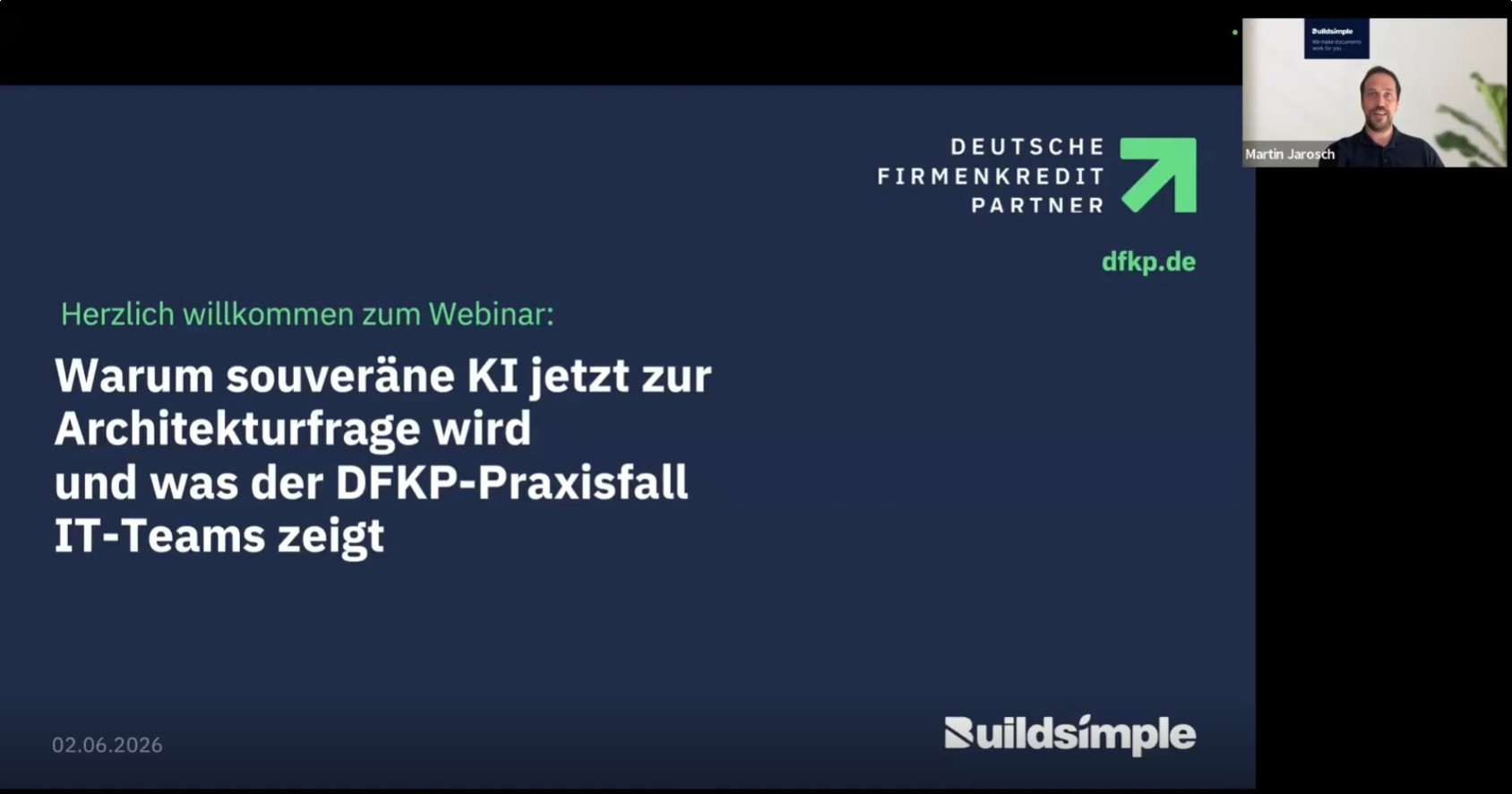
DFKP & Buildsimple Webinar
AI sovereignty is becoming an architectural issue
dated June 2, 2026