
Buildsimple receives "AWS Qualified Software" certification
When cloud risks are thoroughly documented, audit processes become clearer, there are fewer follow-up questions, and approvals become more predictable. This is precisely why passing the AWS Foundational Technical Review is relevant for IT management, security, and compliance.

Buildsimple has passed the AWS Foundational Technical Review (FTR) and has therefore earned the status AWS Qualified Software. For companies, this is not merely a partner label, but visible proof that the solution has successfully passed an AWS review of key requirements related to security, reliability, and operational excellence. According to AWS, the FTR serves to identify and reduce technical risks; with an approved FTR, the solution receives the Qualified Software badge.
This is relevant for compliance, security, and IT management because vendor and approval processes depend on whether the architecture, operating model, data processing, and standards are documented in a way that makes internal assessments reliable. This is precisely where an external review improves the factual basis: less gut feeling, more traceable criteria. This conclusion is a sound deduction based on AWS’s FTR purpose and Buildsimple’s publicly documented evidence.
What AWS checks during the FTR
AWS describes the Foundational Technical Review as an assessment of a subset of AWS Well-Architected best practices, with a focus on reducing risks in the areas of security, reliability, and operational excellence. Upon successful completion, the solution receives the Qualified Software badge and is listed in the AWS Partner Solutions Finder.
For IT teams, this does not mean that a vendor review is “complete.” It does mean, however, that there is important external evidence available that can be integrated into internal audits and helps structure discussions. This is a reasonable conclusion, though one that is deliberately phrased as a classification.
What's even more important for secure AI applications than a badge
The key point is not the label alone. What matters is how an AI solution is developed, operated, and monitored. At Buildsimple, choosing an AI strategy is explicitly a technical, domain-specific, and business decision—not a blanket approach of “solving everything with LLMs.” There are four strategic levels:
- machine learning and deep learning models trained in-house,
- Foundation models,
- Generative AI using large language models, as well as
- AI agents and AI-based processes.
In a direct comparison, Gen-AI/LLMs offer a quick zero-shot start and strong results for complex linguistic tasks, but come with higher latency, decision logic that is harder to explain, and unclear pricing trends. Small, specialized ML models require more training effort but deliver fast inference, stable responses without hallucinations, high efficiency at high volumes, and greater transparency through proprietary training data.
Buildsimple illustrates this with a hybrid target architecture: approximately 80% specialized small models for large-scale data and approximately 20% large language models for complex cases. For IT decision-makers, this is precisely the key point: in this context, secure AI does not mean “one model for everything,” but rather the right AI strategy for the right use case.
What Makes AI Development at Buildsimple Secure
Several requirements are essential for productive AI: legal compliance, governance, and oversight; quality monitoring and assurance; versioning and staging for stable production; human-in-the-loop intervention to correct erroneous decisions; availability and stability; as well as transparency, traceability, and explainability. AI solutions must support business-transaction-related enterprise processes, as their cost-effectiveness depends on volume, costs, and throughput.
This logic is precisely what matters most for SaaS security: not only must the cloud platform be resilient, but so must the selection, combination, versioning, and control of the AI processes used. This is the strongest link between AWS certification and operational customer value.
Conclusion
For Buildsimple, the AWS Qualified Software designation is more than just a marketing tool. For IT management, security, and compliance teams, it serves as additional external evidence that the platform systematically addresses key AWS requirements. Together with the publicly documented certifications for ISO 27001, hosting in Frankfurt, BaFin-regulated companies, and the documented security and compliance framework, this enhances the solution’s evaluability for you in vendor and approval processes.
Anyone who uses the Buildsimple platform in a structured way and evaluate it more effectively, should take the next step and watch the webinar recording . If you have any questions regarding security and compliance, Malte Sukopp is your contact person, and for an initial consultation on using Buildsimple, Martin Jarosch and Sabrina Terbille are available at sales@buildsimple.de .
Latest posts


Don't miss any news
Subscribe to our newsletter for the latest news, developments and functions relating to Buildsimple.
Practical insight
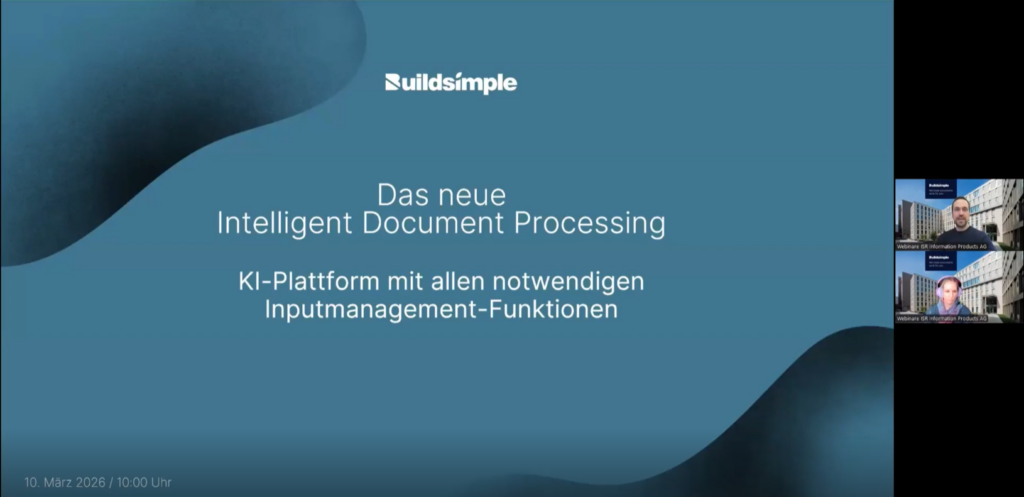
Learn more in 45 minutes how Intelligent Document Processing your slow, manual and and inbound mail processes . See it live how e-emails, PDFs and scans to structured data – for faster processes, reduced teams and greater compliance. Instead of theory offers you this webinar practical insights and a clear roadmap: from first pilot to to production deployment.
We answer your questions
Buildsimple has passed the AWS Foundational Technical Review (FTR) and has thus earned the status of AWS Qualified Software. AWS classifies the FTR as a review designed to identify and mitigate technical risks; it assesses key requirements in the areas of security, reliability, and operational excellence.
Because an external review improves the basis for assessment. For internal audit processes, it is crucial that the architecture, operating model, and supporting documentation are in place so that risks can be assessed with confidence. Buildsimple explicitly highlights this connection on its AWS Qualified Software page in relation to compliance, security, and IT governance.
Buildsimple publicly documents several security and compliance measures: ISO 27001, security and compliance information, hosting of the product infrastructure in Frankfurt am Main, secure HTTPS interfaces, and use in companies regulated by BaFin. In addition, Buildsimple references a C5-certified cloud in Frankfurt am Main (AWS).
For European customers, hosting takes place in Frankfurt am Main (eu-central-1), which is also the processing region in the standard setup. When using large language models (LLMs), processing may also take place in other EU countries, depending on the model and setup used. The public Buildsimple page lists Frankfurt am Main as the hosting location for the product infrastructure.
Among other things, the following are publicly disclosed: ISO 27001, the GDPR, an AVV process, details regarding hosting and data processing, AWS as a subprocessor, as well as publicly available references and certifications. Buildsimple specifically highlights these credentials in the context of its successful AWS FTR certification.
Buildsimple does not rely exclusively on a single AI method, but instead selects the most appropriate approach for each use case from among self-trained machine learning and deep learning models, foundation models, large language models (LLMs), as well as AI agents and AI-based processes. Technical, domain-specific, and economic factors play a decisive role in this decision-making process.
While large language models are highly effective at handling complex linguistic tasks, they also have drawbacks: higher latency, decision-making logic that is harder to explain, high infrastructure requirements, and pricing trends that are difficult to predict. Small, specialized ML models are more stable, transparent, and cost-effective in many big data scenarios.
Buildsimple employs a hybrid architecture: approximately 80% specialized small models for large-scale data and approximately 20% large language models for complex cases. The goal is greater controllability, consistent quality, and more cost-effective production operations.
Key components include versioning, staging, monitoring, and quality assurance; human-in-the-loop mechanisms for reviewing and correcting erroneous decisions; as well as transparency, traceability, and explainability. These elements are described as non-optional.
Because documentation, architectural information, and operational data are presented in a structured format, reducing the need for interpretation. Buildsimple emphasizes precisely this benefit in its communications regarding AWS Qualified Software and Security & Compliance: faster, more reliable decisions for compliance, security, and IT leadership.
Yes. Buildsimple publicly highlights its use in companies regulated by BaFin and features references from regulated industries such as insurance on its website.
For questions regarding security and compliance, interested parties can contact Malte Sukopp . For an initial consultation on using Buildsimple, please contact Martin Jarosch, Sabrina Terbille or sales@buildsimple.de are the appropriate contacts. The Security & Compliance page and the Buildsimple News section provide links to the relevant contact information.
Questions about compliance, security, or vendor approval?
Contact our expert:

Malte Sukopp
Data protection & security